
CERTIFIED WORKPLACE MEDIATOR AND TRAINER
Workplace Conflict
Solutions to navigate tension and restore working relationships.
Mediation and Facilitation
Training
1:1 Coaching
CDP-I Assessments

Conflict in the workplace is common. A process for it isn't.
THE GAP
Ever wake up at 3 a.m. ruminating about a work relationship and how to handle it? You are not alone.
85% of employees report dealing with conflict at work—and nearly one in five employees say they have seen people leave their organization because of conflict.
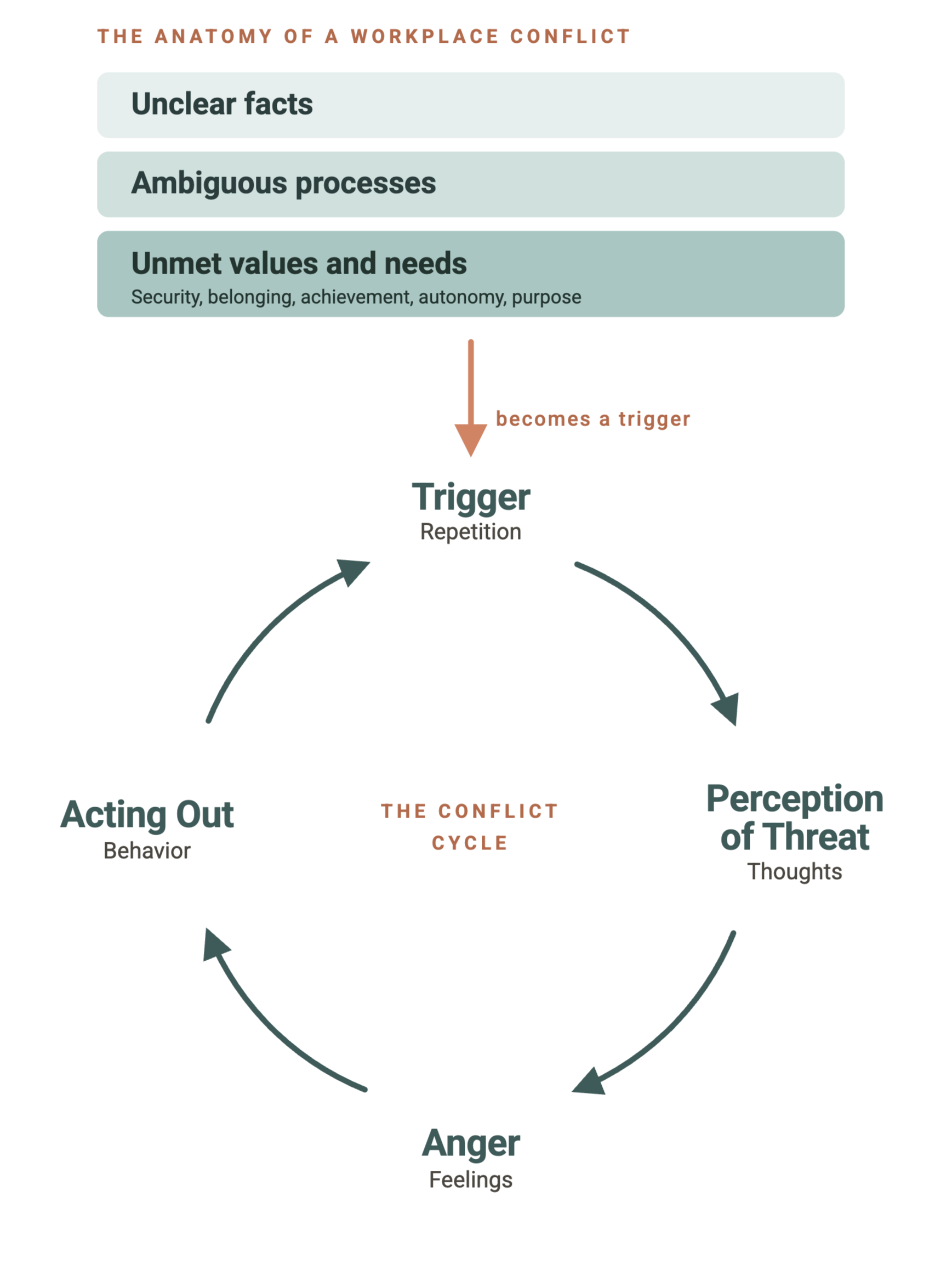
Yet few of us have learned how to recognize conflict as it’s developing, see the patterns underneath it, understand our own triggers and habitual responses, and develop the skills to navigate it constructively.
Moreover, organizations tend to interpret problems through the processes they have available. So as conflict heats up, instead of asking, “Does this conflict need support?” we ask:
Is this a performance problem?
Is this a disciplinary issue?
Does this require an investigation?
These are important processes, but they were designed to solve different problems.
When workplace conflict is enters one of these workflows, the outcome is shaped by the process itself. Instead of helping people understand one another and reach a solution, the organization begins documenting performance, determining whether policies were violated, and mitigating risk.
Because formal processes are inherently threatening, conflict often becomes more entrenched, relationships deteriorate, trust erodes, productivity declines, and people leave—by choice or otherwise.
THE COST
Who and What is Harmed
The absence of a conflict management process burdens all levels of an organization.
When people feel emotionally threatened, they direct their energy toward self-protection instead of collaboration, creativity, and contribution.
Employees
A classic management study revealed that up to 30% of a typical manager's time is spent dealing with conflict.
Managers
.
Human Resources
HR professionals are often expected to address interpersonal conflict using mismatched processes. The consequence is an erosion of trust in the processes themselves.
Conflict rarely stays contained to the two people involved. Left unaddressed, destructive behaviors—including blaming and gossiping—spread outward for the team to absorb.
Culture
Leaders absorb the downstream costs of conflict: turnover, reduced productivity, weakened culture, and diminished confidence that organizational processes are producing fair resolutions.
Leaders
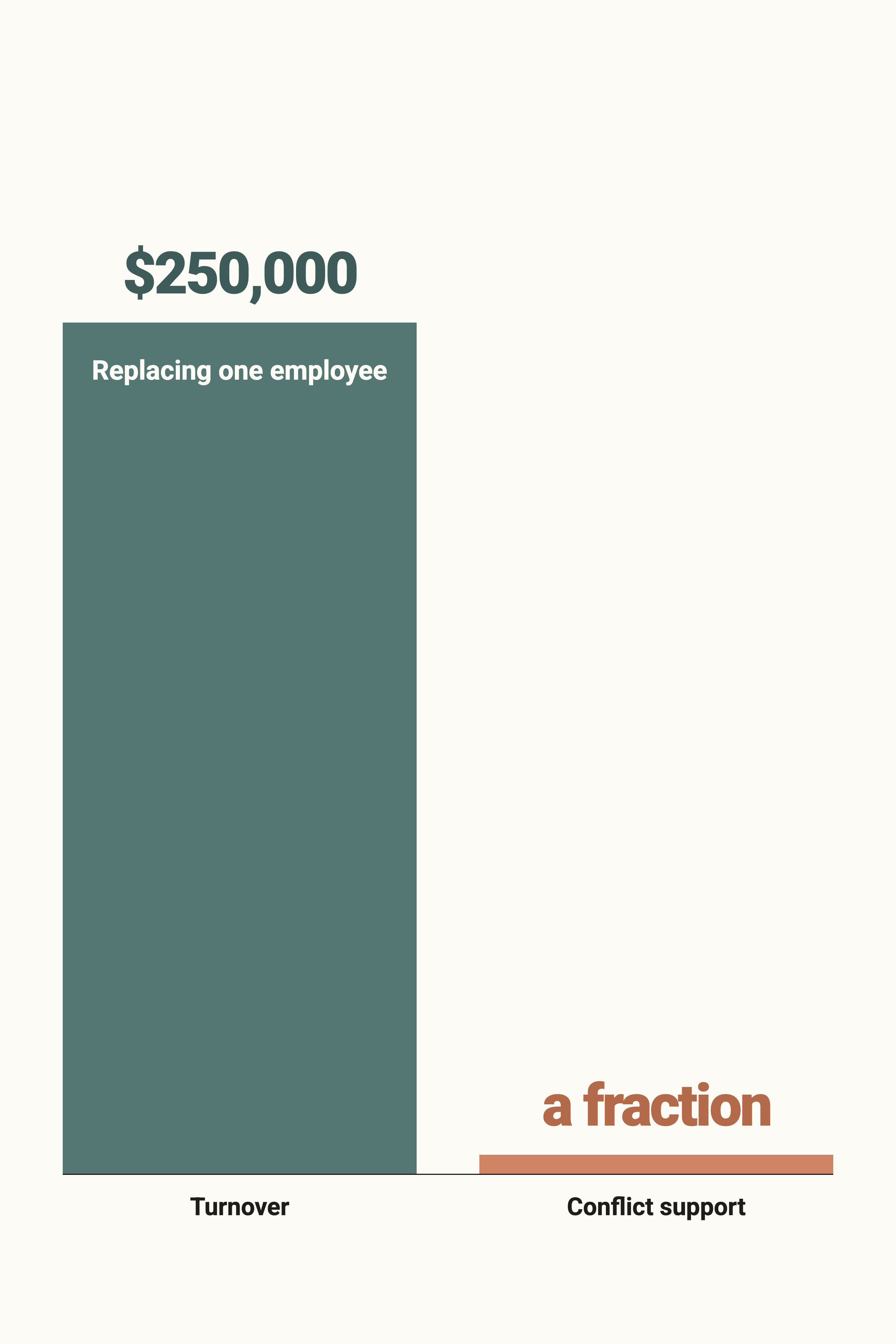
Replacing an employee can cost up to 2.5x times their annual salary once recruiting, onboarding, lost productivity, and institutional knowledge are taken into account. With a base salary of $100,000/year, the turnover cost is $250,000. One departure costs far more than preventing it.
The Bottom Line

Conflict Management Solutions
With the right support, conflict doesn’t need to be destructive or costly. It can be transformative.
Genevieve Croteau is a certified Workplace Conflict Mediator and Trainer and an International Mediation Institute (IMI) qualified Mediator. In addition, she brings over 25,000 hours of experience across leadership, operations, and Human Resources—including more than a decade coaching senior leaders and working at the C-suite level as a Chief Operating Officer. This combination allows her to understand workplace conflict not only at the interpersonal level, but within the broader context of the organization.
When you work with Genevieve, the process begins with a discovery call to determine which conflicts are appropriate for mediation and what level of support you need. This support may include CDP-I® assessments, conflict coaching, mediation, group training, leadership team consulting—or some combination of these. Genevieve also helps the individuals involved understand the process, as mediation must be voluntary.
1:1 Coaching to Develop Constructive Conflict Skills
From an individual perspective, conflict coaching involves developing cognitive, emotional, and behavioral skills that enable you to manage your own reactions, clarify what is happening in the situation, and engage constructively with the other party to find solutions to issues arising from the conflict.
Coaching includes a values exploration based on the Schwartz Theory of Universal Human Values to surface “the way” behind conflict reactions—what we’re protecting when in a conflict.
The result of years of research and development, the Conflict Dynamics Profile® (CDP-I) is unlike any other assessment tool in that it measures conflict behaviors, rather than styles. It delivers specific, personalized insights that help individuals and teams understand what triggers conflict and recognize their patterned responses, while providing a compass for managing conflict more effectively.
Neutral, Third Party Mediation and Facilitation for Conflict Resolution
Mediation is a structured, teachable process that empowers two parties to develop solutions to resolve their own conflict.
Mediation has a 90% success rate.
The method helps shift both parties from from threat response to thoughtful response and builds understanding.
The facilitator helps depersonalize the conflict by placing it in a broader context and engaging the parties to solve a business problem.
Mediation is often paired with self-assessments and individual coaching to prepare each party.
Team Training
Training builds conflict management as a shared, organizational skill.
Includes Conflict Dynamics Profile® (CDP-I) for the entire group.
Teaches simple and memorable framework for recognizing conflict patterns and responses.
Introduces tools like self-mediation to handle conflict directly.
Engages the entire team in building a constructive conflict organization.

I've seen misunderstanding escalate and become workplace trauma too many times. As a leader and HR professional, it’s my responsibility to help improve the system.
— Genevieve
FAQs
-
This approach is appropriate when:
There is open interpersonal tension, misalignment, or breakdown in working relationships;
The situation is impacting team effectiveness of individual or team performance;
Both parties are able and willing to engage voluntarily.
It is not appropriate in cases involving concerns or allegations of harassment, discrimination, or other matters that require formal investigation or legal intervention.
-
Theory Y Conflict Coaching is not an investigative or disciplinary process. It does not determine fault. Instead, it is a structured, facilitated process designed to help individuals clarify perspectives, surface misunderstandings, and develop a shared understanding of the situation, while skill-building. It is particularly effective in situations where concerns exist, but a formal investigation is not warranted.
-
No. Participation in mediation does not preclude, limit, or waive the right to initiate or file a formal complaint or in any other way impede on the organization’s polices.
-
The consultant serves as a neutral mediator and facilitator. Their role is to ensure each perspective is heard, understood, and given equal consideration, and to bring clarity, synthesize perspectives, and guide a constructive path forward.
-
An follow up report is provided to participants, managers, and Human Resources. This report includes:
Context, background, and facts
Each participant’s perspective (shared only with explicit consent)
Relevant organizational or structural factors
Agreements made during mediation
-
The consultant is bound by professional confidentiality and handles all information with discretion and care. However, confidentiality is not absolute:
An Insight Report is shared with supervisors Human Resources;
Legal or organizational obligations may require disclosure in certain circumstances.
The process is designed to balance psychological safety with organizational policy.
-
Only with consent, interviews may be recorded and processed using AI-assisted tools. However, recordings are not shared and remain confidential.
-
By addressing conflict earlier and more directly, this process can:
Provide a meaningful support service to employees who are struggling;
Prevent escalation into formal complaints, especially when unwarranted;
Reduce the likelihood of turnover;
Identify organizational gaps that can be easily cured;
Enables people to work through differences directly.
-
Yes, participants sign a simple memo of understanding that outlines the process and confirms their consent.
-
Most engagements are completed over a 2-3 week period, depending on complexity, availability, and number of participants.
Here’s what leaders say
-
![]()
Stephen Rhind-Tutt
PRESIDENT, COHERENT DIGITAL
All of us at Coherent are deeply grateful for all you have done for us. You helped attract so many great people to Coherent, you helped build so many systems and processes and you were instrumental in making us an inclusive, fun and exciting company. You never hestitated to tell me where you thought I was making mistakes and how I could improve. I am very grateful.
-
![]()
Andi McDaniel
CHIEF CREATIVE OFFICER, CITY CAST
It’s incredibly rare to find someone who is as competent and as strategic as Genevieve while still being empathic, present, and kind. She is so genuinely passionate about helping leaders and teams work better together, and she is the unicorn who can make it happen. I would work with her again in almost any capacity. She is truly a marvel.
-
![]()
Chris Valentini
FORMER COO, ITV AMERICA
During the acquisition of Sirens Media by Leftfield Pictures, Genevieve played a pivotal role in bridging two distinct company cultures. She brought empathy and clarity at a time when balancing organizational demands with the human side of change was no small task. Her ability to foster collaboration and trust made the integration far smoother than it might have been, and it’s something I continue to admire when I look back on that period.
-
![]()
Rebecca Toth Diefenbach
FORMER PRESIDENT, SIRENS MEDIA
Genevieve has a talent for seeing what lies ahead and helping organizations plan in advance. She excels at gathering people, guiding brainstorming sessions, and drawing out the best ideas.




It is my belief that many analyses of other human beings are tragic expressions of our own values and needs.
— Marshall Rosenberg, Nonviolent Communication